


Submission successful
Cancel

Aug.15.2026
Back

As the longest-lived typhoon of the year, "White Dolphin" recently made its return to the eastern coastal regions. The abundant moisture carried by its remnant vortex triggered a cascade of heavy rain warnings, with torrential downpours plunging many areas into what could only be described as "sea-watching mode."
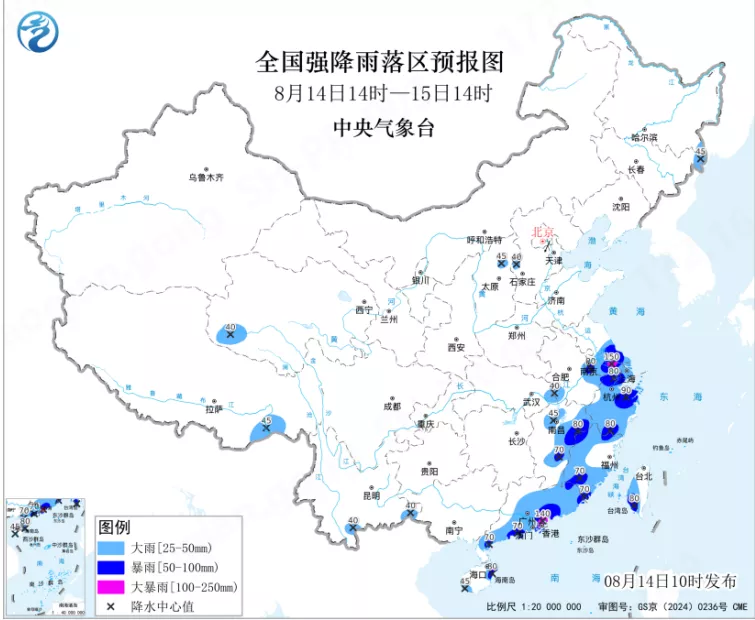
(Forecasters at the National Meteorological Center continued to issue an orange rainstorm alert as of 10:00 AM on August 14.)
In the face of such unpredictable typhoons, timely, precise, and long-lead meteorological forecasting serves as the critical first line of defense — enabling early deployment, scientific coordination, and measured response. During the critical window of "White Dolphin's" landfall, Insight Space-Time's StarQue Foundation Model was put to the test in real-world conditions, delivering a compelling demonstration of its operational prowess.
High Precision, Long Lead: StarQue Delivers a "Top-Tier Performance"
Throughout the full-cycle forecasting of Typhoon "White Dolphin," the StarQue Foundation Model demonstrated systematic advantages across two core dimensions: medium-to-long-term typhoon track projection and advanced precipitation prediction.
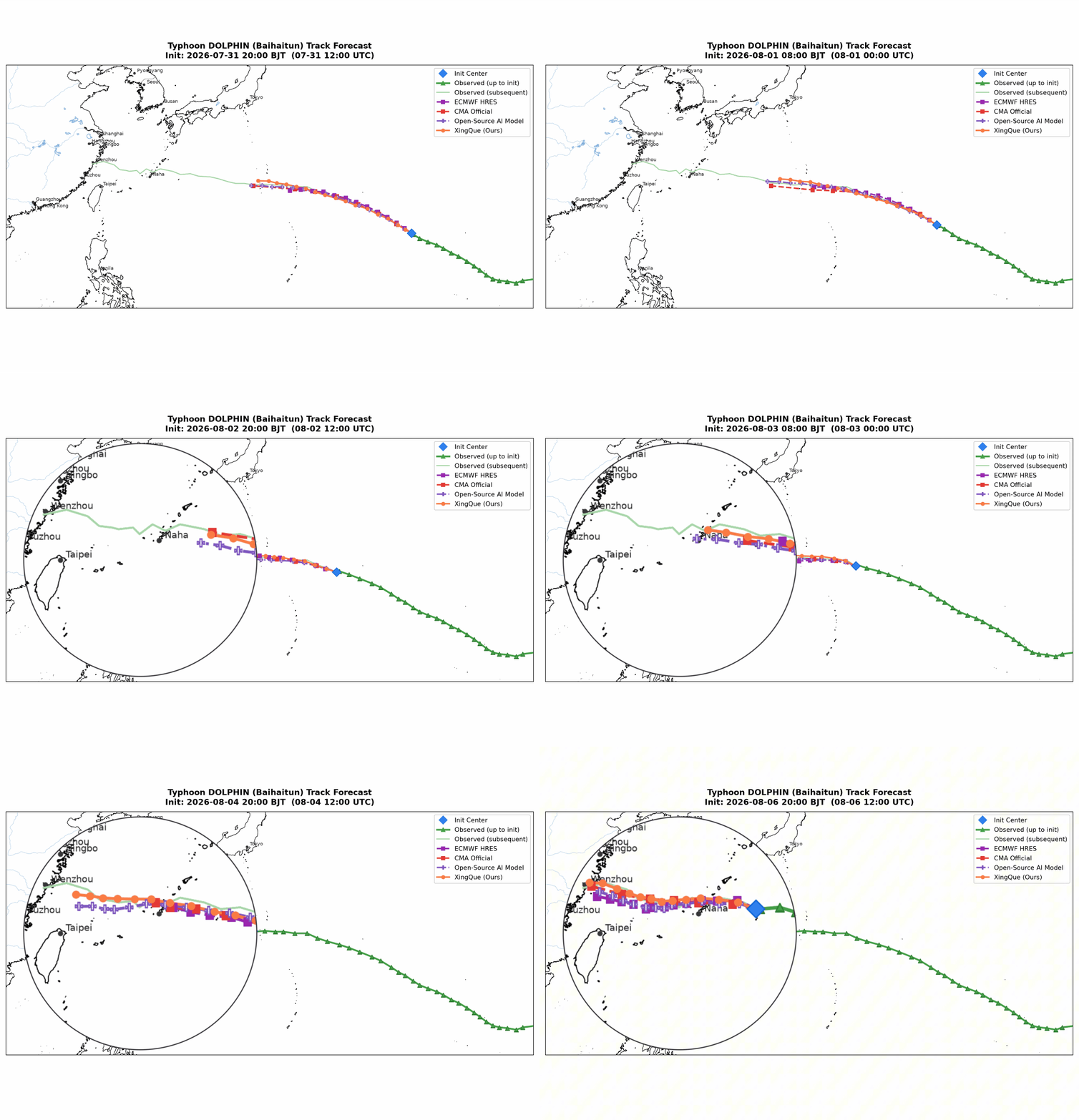
(In the figure, the orange solid circles represent the StarQue Foundation Model's predicted track, while the light green fine line denotes the typhoon's actual path — the two trajectories show a remarkably high degree of coincidence.)
In terms of typhoon track forecasting, the model performed robustly during the critical 72-hour and 96-hour decision-making windows. Compared to leading traditional numerical weather prediction models such as CMA (China Meteorological Administration) and ECMWF HRES (European Centre for Medium-Range Weather Forecasts), as well as peer AI models of the same category, the average position error was reduced by approximately 20% to 30% , enabling precise identification of the typhoon's movement trajectory, forward speed, and evolutionary trends.
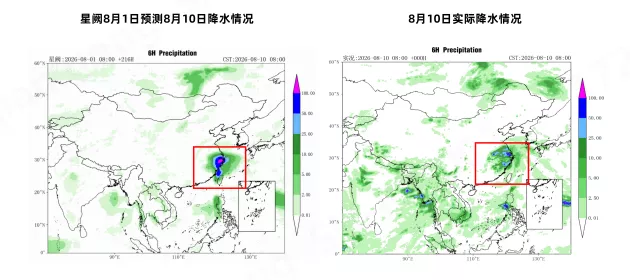
(The red box in the figure delineates the core precipitation zone of "White Dolphin"; StarQue's predicted area and the actual precipitation zone show a high degree of overlap.)
On the precipitation forecasting front, the StarQue Foundation Model achieved an advanced, highly accurate prediction of typhoon-related rainfall. As early as August 1, the model successfully forecast the core precipitation zone associated with Typhoon "White Dolphin" on August 10 — capturing with precision the regional rainfall variations induced by the typhoon's outer circulation. This effectively addresses a long-standing industry shortfall: the lack of accuracy in medium-to-long-term typhoon precipitation forecasting. Such superior "advance warning" capability provides emergency response systems with a sufficiently generous decision-making lead time.
The Physical World Foundation Model: Fortifying the Technological Backbone of AI-Powered Forecasting
As a forecasting-oriented product within the broader Physical World Foundation Model ecosystem, the StarQue Foundation Model is built upon a Mixture of Experts (MoE) architecture, a multi-modal spatiotemporal information collaborative representation mechanism, and a physics-constrained spatiotemporal evolution learning framework. Trained on over 400 TB of multi-source heterogeneous data — including satellite remote sensing, reanalysis datasets, station observations, and disaster-triggering factors — the model demonstrates robust unified modeling and cross-task transfer capabilities across multiple timescales, from nowcasting and short-term to medium-to-long-term forecasting.
Currently, the StarQue Foundation Model has been deployed on the meteorological AI foundation model platform jointly developed by the Jiangsu Provincial Meteorological Service Center and Insight Space-Time, providing unified, reliable data and algorithmic support for meteorological monitoring, forecasting services, disaster early warning, and scientific research applications. Building on this foundation, the platform enables the training, fine-tuning, and development of AI foundation models, leveraging high-quality training datasets and professional validation capabilities to continuously enhance model accuracy and performance.
Prev
Insight Space-Time Elected to Governing Board of Shanghai Artificial Intelligence Industry Association — Full-Stack "Commercial Space + AI" Capabilities Recognized by the IndustryNext
WAIC 2026 Insight Space-Time Keynote Report | AI Deep-Space Intelligence Ushers in a New Paradigm of Heaven-Earth ComputingBack
Newsroom
Last news

Insight Space-Time AI Research Accepted for Oral Presentation at KDD 2027, the Top International Conference on AI & Data Mining
Learn more
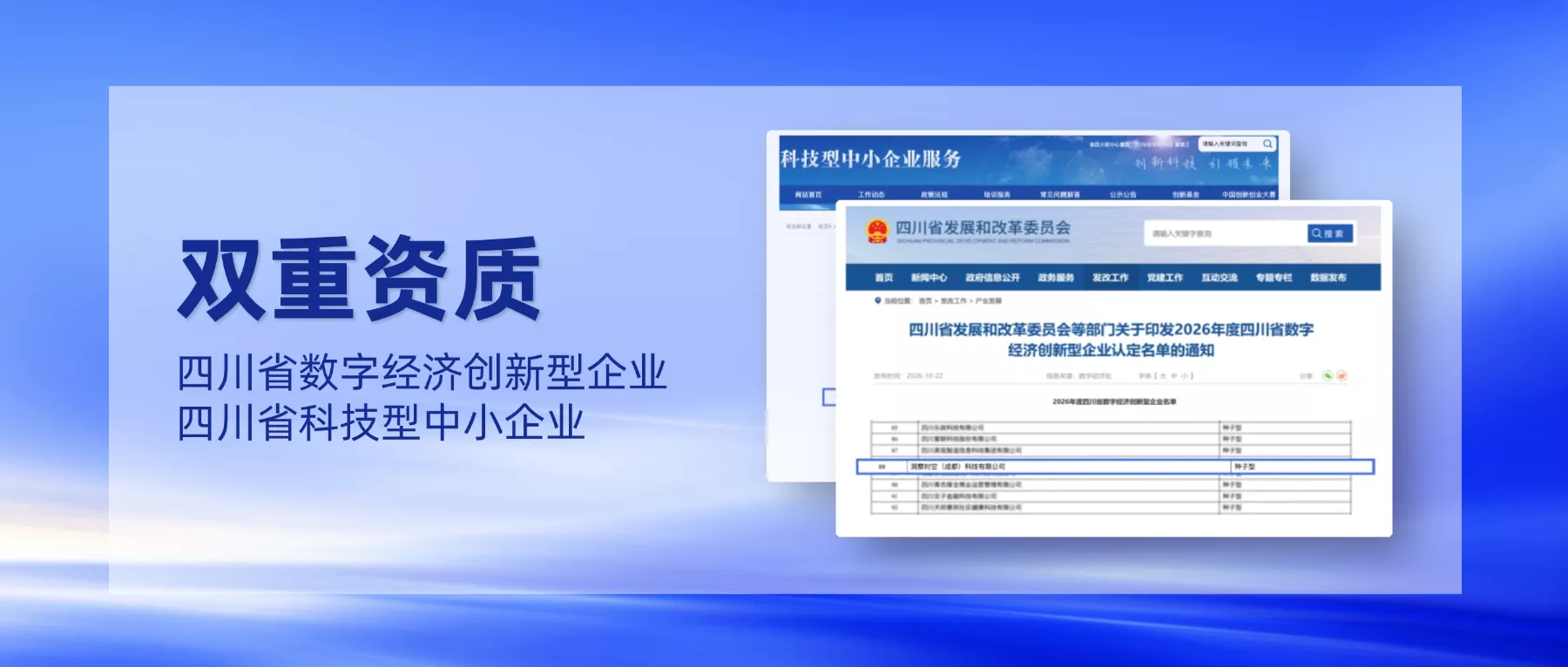
Strength and Potential Both Recognized by the Government: Insight Space-Time Named a Sichuan Digital Economy Innovative Enterprise and a Technology-Based SME
Learn more
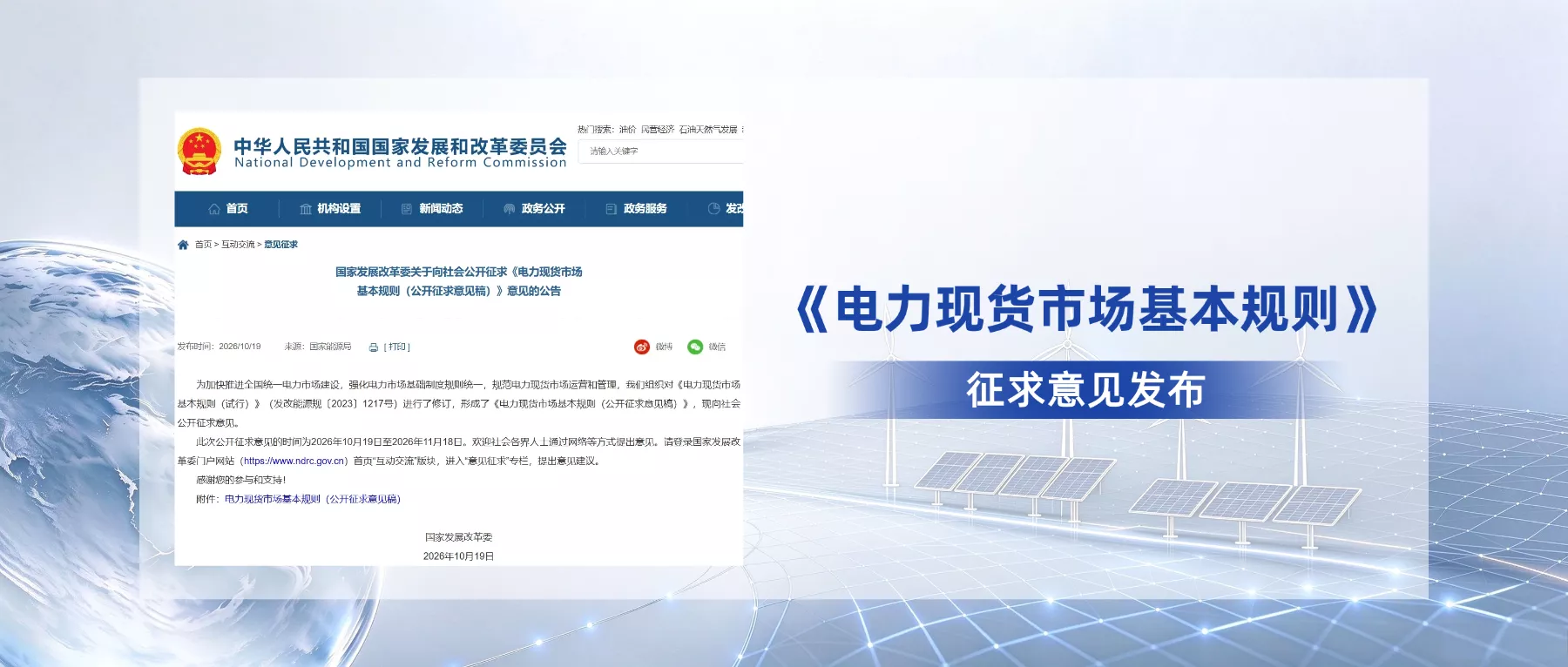
New Rules for the Electricity Spot Market Are Here: StarQue Foundation Model Helps the New Energy Power Industry Build Core Competitiveness
Learn more
Contact Us
Submit


© 2026 Insight Time-Space. All rights reserved. |
Privacy Policy